
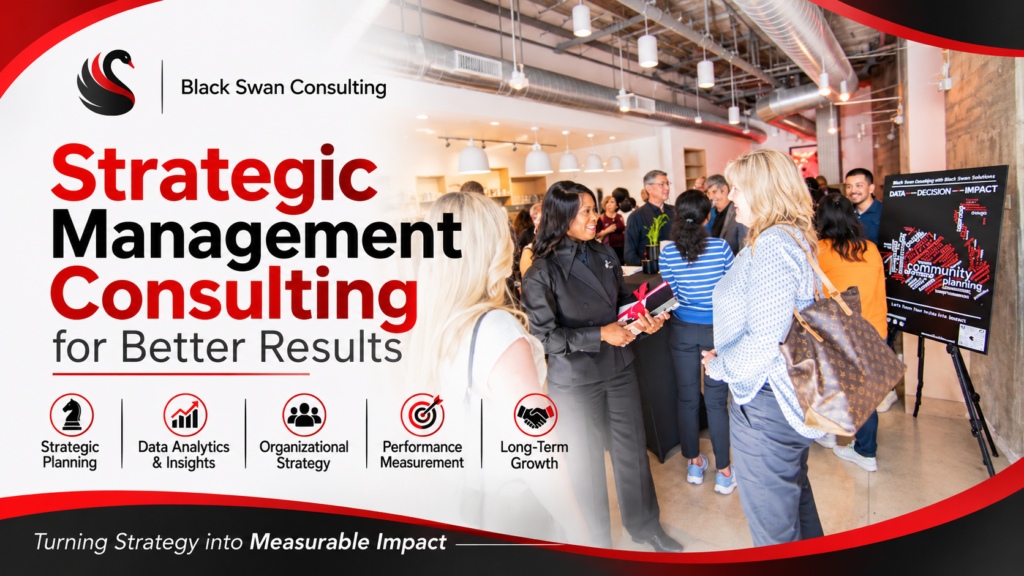
Organizations across government, healthcare, nonprofit, and corporate sectors face increasingly complex challenges. Managing resources, aligning stakeholders, improving operations, and demonstrating measurable outcomes require clear direction and informed decision-making. Without a structured strategy, even organizations with strong teams and valuable resources may struggle to turn their objectives into meaningful results.
This is why strategic management consulting firms play an important role. They help leadership teams assess organizational needs, identify performance gaps, establish priorities, and develop actionable plans. Through research, data analysis, and strategic guidance, organizations can make better decisions and improve their ability to achieve long-term goals.
What Do Strategic Management Consulting Firms Do?
Strategic management consulting firms support organizations in evaluating their current operations and developing strategies for improvement. Their work often involves understanding organizational challenges, reviewing existing processes, assessing performance, and recommending practical solutions.
Key areas of support include:
- Strategic planning and implementation.
- Organizational assessments and gap analysis.
- Data analytics and impact reporting.
- Program evaluation and performance measurement.
- Stakeholder engagement and leadership alignment.
- Organizational development and capacity building.
These services help organizations connect their priorities with measurable objectives and establish a clearer direction for future activities.
Why Organizational Strategy Consulting Matters
A well-developed strategy provides a framework for setting priorities, assigning responsibilities, and measuring progress. However, organizations sometimes struggle to align different departments, engage stakeholders, or translate long-term objectives into practical activities.
Organizational strategy consulting helps address these challenges through structured assessments and planning processes.
For example, a nonprofit organization may need to improve its internal capacity while meeting funder expectations. An organizational assessment can identify resource gaps, operational challenges, and opportunities for improvement. Based on these findings, leadership can establish priorities and develop an implementation roadmap.
Similarly, public-sector organizations can benefit from strategic planning that considers community needs, policy expectations, stakeholder perspectives, and available resources.
The Importance of Data Analytics and Performance Measurement
Reliable information is essential for effective organizational management. Businesses and institutions collect significant amounts of data through reports, surveys, operational systems, and stakeholder feedback. However, collecting information is only one part of the process. Organizations must also understand what the information reveals.
Data analytics helps transform complex information into practical insights. It allows leadership teams to identify trends, evaluate performance, and recognize areas that require attention.
Performance measurement also helps organizations:
- Establish meaningful key performance indicators (KPIs).
- Monitor progress against organizational objectives.
- Evaluate program effectiveness.
- Identify operational gaps and improvement opportunities.
- Communicate results to funders, boards, and stakeholders.
Combining quantitative and qualitative research provides a broader understanding of organizational performance and supports evidence-based decisions.
How Financial Advisory Consulting Firms Support Organizational Decisions
Financial planning and organizational strategy are closely connected. Leadership teams must understand available resources, projected expenses, and funding requirements when establishing priorities.
Financial advisory consulting firms can help organizations evaluate financial information, develop forecasts, and understand the potential implications of resource allocation decisions.
For nonprofits and public agencies, financial insight can also support funding decisions, program sustainability, and accountability requirements.
Integrating financial planning with organizational assessments and performance analysis helps decision-makers evaluate whether their priorities are realistic and aligned with available resources.
The Role of Advisory Consultants in Organizational Growth
Organizations often need an independent perspective when navigating change, addressing performance challenges, or planning new initiatives. Advisory consultants can provide structured guidance by reviewing existing operations, evaluating organizational capacity, and identifying opportunities for improvement.
Their work may include stakeholder interviews, organizational assessments, strategic workshops, and implementation planning.
Effective advisory support also considers the perspectives of employees, leadership teams, community partners, and other stakeholders. Engaging these groups helps organizations understand different priorities and build agreement around shared objectives.
This approach is particularly valuable for organizations managing complex programs or working across multiple departments and communities.
Turning Strategic Plans Into Measurable Outcomes
Developing a strategic plan is only the beginning. Organizations must also establish clear responsibilities, implementation timelines, and performance indicators to translate recommendations into action.
A structured approach can include:
- Planning: Define organizational goals, priorities, and expected outcomes.
- Assessment: Review current capabilities, challenges, and performance gaps.
- Analytics: Examine available information to support important decisions.
- Research: Incorporate relevant evidence, stakeholder feedback, and findings.
- Reporting: Present recommendations, performance insights, and implementation guidance.
This integrated process helps leadership teams move beyond planning documents and focus on practical execution.
Conclusion
Organizational success requires clear priorities, reliable information, effective collaboration, and consistent performance evaluation. Strategic planning, data analytics, program evaluation, and stakeholder engagement help organizations understand their challenges and develop practical solutions.
Black Swan Consulting supports government agencies, healthcare organizations, nonprofits, and corporate leaders through strategic planning, data analytics, needs assessments, program evaluation, and organizational advisory services. Its PAARR™ Framework—Planning, Assessment, Analytics, Research, and Reporting—helps turn complex information into actionable insights, stronger accountability, and measurable organizational impact.